Tuesday, January 25, 2011

Did someone say HALOUMI?


I love you, Landmark Plaza.  You do come up with some delightful surprises sometimes, don’t you?  The day I returned to Dili after our xmas holidays and perused your many fridges, all the stars aligned.  I was meant to have this haloumi.  I don’t even care that it cost something like $13.  This relationship was meant to be. 

So, stuff the healthy crap!  Let’s fry up some squeaky, cheesy goodness and get this year started properly!

The accompanying risotto is purely a bed on which to lovingly place the bubbling, yellow, oozing cheese, so you can ad-lib as per your available ingredients.  I had eggplant, green beans and spinach and some wholegrain mustard in the fridge.  This latter ingredient has made frequent appearances in my risottos ever since my friend and former flatmate, AB, introduced it to me back in our old Juliett Street days.  I urge you to try it.  It adds some good flavour especially if, like us, you don’t have any vegetarian stock cubes lying about and/or are too lazy to make your own veggie stock, and so can only cook the rice in water.  

Fried haloumi atop a mound of eggplant risotto

For the haloumi:
2 x 1cm thick slices squeaky cheese (aka haloumi)
Drizzle olive oil
Lemon wedges, to serve

For the risotto:
1 medium eggplant, sliced about ½ cm thick (I used 3 long skinny ones because that’s all we get here)
½ cup olive oil
1 onion, diced
2 cloves garlic, crushed
1 ½ cups uncooked Arborio or carnaroli rice
1 cup dry white wine
 4 cups (approx) chicken/vegetable stock OR water (try not to make it water if you can help it)
Zest of half a lemon, finely grated (optional – if you like lemons a lot)
2 tsps wholegrain mustard
10 green beans (or 3 snake beans, etc), chopped
A handful of spinach leaves, roughly chopped
1 cup(-ish) fresh parmesan cheese, finely grated
A handful of chopped, fresh herbs (e.g. parsley, basil or oregano)
Salt and pepper

First, put your stock in a saucepan and bring it to a simmer.

Meanwhile, fry up the eggplant.  Make sure the pan is hot before adding about half the olive oil and then the eggplant slices, in batches.  Fry until golden, adding more oil if necessary.  Set aside.

Heat about 2 tablespoons of the remaining oil and fry the onion and garlic over a medium heat until soft.  Turn the heat up to medium-high, add the rice and stir to coat with oil.  Let the rice toast for a bit – it might get a bit dry and sticky on the bottom of the pan – this is ok, but keep stirring it so it doesn’t burn.

Add the wine, close your eyes and nod your head in satisfaction at the sizzle and the aroma!  Keep stirring!

When most of the wine has been absorbed, add a ladle of the hot stock while continuing to stir the rice.  And then once that liquid has been absorbed, add another ladle.  Continue this process, stirring all the while until such time as you think the rice is almost cooked – it shouldn’t be too gluggy or soft; it should still have some “bite”, but not crunch.  Also, the heat should be adjusted so that it isn’t furiously boiling, but you’ve got some good bubble action happening.  Got that?  Excellent!

Just before you add the final ladle of stock, add the lemon zest, mustard, beans and spinach.  Give it another good stir and add your final ladle.  This should finish cooking the rice perfectly.  Turn off the heat, stir in the parmesan, herbs and seasoning and then whack on the lid to rest for five minutes, while you bring out the star of the show:  The Haloumi.

Heat a small frying pan over medium heat.  Add a drizzle of olive oil and the haloumi slices.  Cook on both sides until golden and bubbling.

Now, without delay (preferably while the haloumi is still cooking), plate up the risotto to await the piping hot cheese.  Squeeze over your lemon and a grinding of pepper and eat immediately.

Monday, January 24, 2011

KAPAOW! CHICKABAH! Healthy meal number 2!


2011 is starting off with all sorts of healthy goodness!  If that lentil salad wasn’t enough for you, this one is surely going to make you glow.

It is impossible to eat a lunch of rice paper rolls and feel anything but cleansed.  And they are really therapeutic to make – you get all the ingredients prepared and then the production line can begin, with everyone taking turns to soak their rice paper and then assemble their rolls.  You can make them as simple or as decadent as you like, but try focussing your vegetables on the crunchy type.  I like a dipping sauce of traditional Thai flavours (fish sauce, lime juice, palm sugar and chilli) or otherwise just sweet chilli sauce.  I also add avocado, fried tempeh, tofu or shredded omelette for a bit more oomph.

Rice paper rolls


Rice paper rounds (about 3 or 4 per person)
Thin rice (vermicelli) noodles
A selection of crunchy vegetables cut into batons such as carrots, cucumber, lettuce, bean sprouts (the freshest you can get)
Roasted peanuts or cashews, chopped

The rice paper can be soaked in cold water (no need for hot) until it becomes malleable.   The noodles will need to be soaked in hot water until soft, and then drained.

Arrange all ingredients on a platter and get ready to roll.  When rolling, may I suggest that you do not try to put in too much filling – your roll will simply fall apart.  And if you plonk it approximately one third from the bottom and side edges, you should have big enough flaps to fold over.  He he.  Flaps.

For this particular lunch I also made a mango salad.  It was going to be a green mango salad, but the green mangoes I bought were unexpectedly ripe inside, so it was quite sweet and mushy, rather than tart and crunchy.  It was still pretty good though.  Ooh, and the other thing I’ve started getting into here in Timor is finely sliced lime, rind and all, used in Thai-style salads and sambals with lots of chilli and salt.  It’s surprisingly good, especially if you are a big fan of limes like I am.

Mango salad

2 firm mangoes, grated/shredded
5 red shallots (the small ones), finely sliced (can substitute eschallots or red onion)
½ punnet cherry tomatoes, halved and squashed
½ a lime, very finely sliced
1 large red chilli, finely sliced
A handful of roasted peanuts, chopped
Fish sauce, to taste
Lime juice, to taste
Palm sugar, to taste (if you're using ripe mangoes you will not need much sugar, if any)

Chuck all ingredients into a big bowl.  Give it a stir, making sure the fish sauce, lime juice, chilli and sugar give a good sweet/sour/salty balance.  You know the drill.

Salad can now be part of the assembly line for THE HEALTHIEST LUNCH IN THE UNIVERSE!

Saturday, January 15, 2011

A New Year’s salad to get you off to a flying start


Welcome to 2011!  Nice to see you again!

I’m back in the beach shack after a lovely xmas break in Sydney, where I managed to eat almost as many laksas as there were days in the holiday.  I was a little light on the baklavas this time – much to my utter disappointment – but managed to get my fill of sweetness by way of some homemade coconut cookies (a present from my nephew), a few too many Ferrero Rochers, and copious amounts of pudding, custard and ice-cream.

Needless to say, I have been looking forward to getting back to the simple life again – home cooking in a place with limited food resources is certainly one way to do it.  To help us along, yesterday I planted some new seeds in the garden - sweet corn, eggplant, cucumber, bok choi, basil, rocket, coriander and dill.  I'm looking forward to watching them grow and, eventually, eating them.  Hopefully we won't have to wait too long.  It's the rainy season in Timor at the moment, so we don't need to worry too much about watering the garden - we just need to hope for a little sunshine from time-to-time.

So, with all this veggie planting yesterday, I fancied a vitamin-laden dinner last night.  After a quick consultation with Stephanie* I came up with this very simple and tasty salad.  The lentils and spinach gave me the super nutrition that I was craving, the sultanas added a welcome sweet surprise to every few mouthfuls, the anchovy and feta was nice and salty, the pine nuts gave crunch and the beetroot, tomato and carrot made it look pretty.  Don’t be fooled by the long list of ingredients though – this was really quick to make and allows for much improvisation.

Lentil and Spinach Vita-Salad

1 cup brown lentils, soaked for 2 hours (reserve 1 cup liquid)
1 medium onion, diced
2 cloves garlic, crushed
1 Tbsp olive oil
2 anchovy fillets (optional)
1 handful sultanas
1 bunch spinach leaves, torn
1 carrot, grated
2 medium (or a punnet of cherry) tomatoes, chopped
2-3 baby beets (fresh or canned – doesn’t really matter), chopped
Zest and juice of 1 lemon
Drizzle good olive oil
Handful pine nuts or walnuts, toasted
Black pepper and, if not using anchovies, salt
Approx 1 Tbsp goat’s feta per person, crumbled.

Fry off the onion and garlic in a frying pan over medium heat until soft but not coloured.  Place the anchovies over the top of the onion and leave for a minute or two – they will “melt”.  Chuck in the sultanas and then the lentils with the reserved liquid.  Cook, stirring occasionally, until the lentils are al dente and liquid has absorbed.  Turn off heat and allow to cool slightly.

Stir in the spinach leaves – how much they wilt will depend on how long you leave the lentil mixture to cool – this is a personal thing.  Stir in the rest of the ingredients, leaving the feta till last to crumble over the individual serves.

Can be eaten warm or cold.


* As in Stephanie Alexander’s cooking bible, The Cook’s Companion.

Wednesday, December 15, 2010

Moroccan Lamb Shanks with pumpkin and sultanas and Mulberry-ade @ Mum’s place

Mum's place

There’s nothing like a good ol’ lamb shank with your dear ol’ mum, is there? 

I’m not quite sure what it is about mums and slow cooking, but it’s all very comforting, and, perhaps combined with some sort of menstrual-related need for iron, I was craving a real fall-off-the-bone meat dish.  So we went with this one:


Moroccan Lamb Shanks with Pumpkin and Sultanas 
Serves 4


1 tablespoon olive oil
4 lamb shanks, French trimmed
2 medium onions, chopped
1 x 420 can chopped tomatoes
1 x thumb-sized piece ginger, grated
1 bunch coriander, chopped
½ cup water
1 tablespoon brown sugar
1 teaspoon ground cinnamon
1 teaspoon salt
1 cup (140g) sultanas
300g peeled pumpkin

Preheat oven to 180 degrees/160 fan forced.
Heat oil in a large pan.  Add lamb shanks. Cook until well browned all over. Transfer lamb shanks to a tagine or ovenproof dish.
Add onions to the same pan, cook, stirring, until soft and golden.
Add tomatoes, ginger, coriander, water, brown sugar, cinnamon, salt and sultanas. Bring to the boil, then pour mixture over lamb shanks in dish.
Cover the dish and cook for 1 hour.
Cut pumpkin into chunky cubes.  Remove lamb from oven; add pumpkin, cover and return to oven for another 30 minutes.  Remove lid, cook for a further 30 minutes or until lamb is very tender.

**

We served it with minted, buttered couscous and steamed asparagus, which was just what we had on-hand.

I also made my favourite (and ridiculously easy) dolloping condiment:  Tahini and yoghurt – simply mix equal-ish quantities of tahini and yoghurt and dollop on anything that resembles Middle-Eastern/North African fare.  It’s simply delicious.

Mulberry-ade


I think my parents live in the most quintessential of suburban streets – in the old fashioned sense.  All the neighbours know each other’s names, they talk to each other over the fence and they offer lemons and, in this instance, mulberries, from their over-abundant trees.  Thanks to the very neighbourly “Pat”, for making this lovely pre-dinner refreshment possible.

2 cups mulberries, stalks removed
2 cups water (approx.)
½ cup sugar (approx – depends on how sweet you want them to be)
Soda water
Ice
Swizzle stick

Put the mulberries into a heavy-based saucepan and add enough water to just cover them.  Sprinkle over the sugar and gently bring to a boil.  Reduce heat and simmer for 30 minutes.  Cool.

The fruit (and some of the juice*) can now be used as a base for pies, crumbles etc.

Fill tall glasses with ice.  Extract a couple of tablespoons of the liquid per glass and top with soda water.  Stir intermittently and thoughtfully with swizzle stick.

* NB – if you’re making a crumble, don’t do what I did and not include any liquid at the bottom of the pie dish.  This made the crumble come out really dry and the fruit sticky.  It needs to be moist!

Monday, December 13, 2010

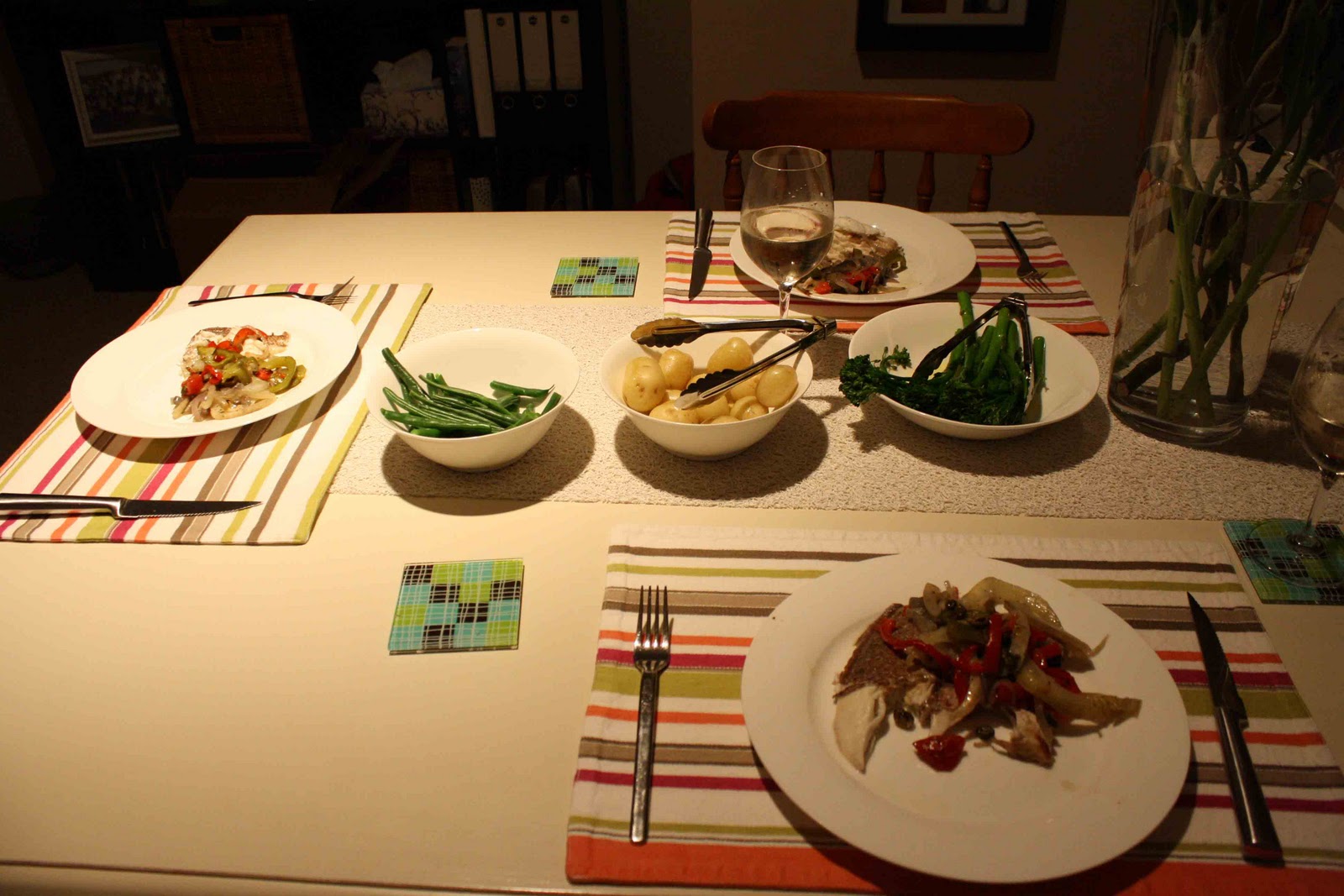
Roast Whole Snapper with Fennel and Olives @ Nin’s place


The main course for Janine’s and my Wollongong cook-off was this little number, courtesy of Neil Perry.  I’m a big fan of many of the flavours used here: anchovies, capers, fennel, olives.   They are fresh, salty and flavourful, reminding me of a lazy afternoon by the sea somewhere in the Mediterranean.  We were in the ‘Gong, which isn’t too far removed.

4 small whole snapper, each weighing 400 – 500g or 1 large one weighing about 1.5-2kg.
1 red onion, finely sliced
1 fennel bulb, finely sliced
2 tablespoons oregano, chopped
2 tablespoons thyme, chopped
60 ml (1/4 cup) extra virgin olive oil
 1 red capsicum, cut in half and finely sliced
3 vine-ripened tomatoes, peeled, deseeded and quartered
2 tablespoons salted baby capers, well rinsed and drained
6 anchovies
150g Ligurian olives
Sea salt
250ml white wine
2 tablespoons chopped flat leaf parsley
Freshly ground pepper

Preheat the oven to 200°. Take a roasting tin and check that it fits your fish; use two tins if necessary. Scatter the onion, fennel, oregano and thyme over the bottom of the tin and drizzle with half the extra virgin olive oil. Put the fish on top and cover with the capsicum, tomato, capers, anchovies and olives. Salt liberally and pour the rest of the oil and the wine over. Cook the smaller fish for 25 minutes, or until cooked, basting every 5 minutes, and the larger fish for 1 hour. Place the fish on individual plates or on a platter. Spoon the sauce and vegetables over and add the parsley and pepper. Serves 4.

**

This was perfect served with boiled new potatoes and steamed greens.  Michael (Janine’s husband) and I washed ours down with some nice Verdelho and I got a bit pissy. 

Roast Garlic Prawns in the shell @ Nin’s place

Nin's place

On a visit to my friend Janine’s new house in Wollongong, we got a bit creative for dinner.  After being in Timor for so long, where browsing through cookbooks is fraught with limitations and negative self-talk (“There are no avocados in the market today, so no guacamole for us”, “Mmmm...SORBET! Oh, that’s right.  No electricity.” etc.), I was really enjoying the freedom of being able to open a cookbook at random and say, “I’m going to cook THAT today”, knowing full well that I could.  Yay!

Rather than choosing at random however, I perused Janine’s collection of cookbooks with great scrutiny, and finally decided on these tasty little morsels:


From Good Weekend magazine

16 prawns, shell on but snipped down the back and de-veined
2 tsp fennel seeds
2 tsp black peppercorns
2 tsp sea salt
50mLs olive oil
1 bunch parsley, chopped
100mL white wine

Marinade
50mLs olive oil
4 cloves garlic, smashed to make a paste

Stir prawns into the marinade ingredients and set aside for half an hour.

Meanwhile, grind fennel seeds, peppercorns and salt in a spice grinder or mortar and pestle to make a powder.  Mix this in with the prawns.

Heat a wok over medium heat for 3 minutes.
Add the olive oil, prawns and the marinade and cook for 2 minutes.  Turn and cook for another 2 minutes.

Add the parsley and white wine, cooking for 30 seconds and then turn out onto a plate to serve. 

No need to get the napkins ready as these are finger-lickin’ good.

An unexpected trip home


Faced with a sudden opening in my very busy East Timor schedule (not), I made a spontaneous decision to take a little holiday in Sydney, which just so happened to coincide with the holidays of my lovely friends, Daniel, Di and Regis (and Thomas and Livia). We relived the old Juliett St/Don St days in a little apartment in Manly with much hilarity and it goes without saying that we were all feelin’ the love. 

But we’re here to talk food, so let’s get down to business.

In short, food was consumed in abundance (I have already facebooked my “baklava-a-day” indulgence – that was just the start of it).  I had the opportunity to sample a few new Sydney haunts, to reacquaint myself with a few old favourites, as well as making my own creations in the kitchens of my family and friends (while revelling in the novelty of going into a greengrocer and finding all the ingredients for any recipe I cared to make at my fingertips). 

I got a bit sidetracked on my foodie photography endeavours at a number of social engagements (having too much fun) and failed to take photos of some of the awesome food I was eating, but I managed to get a few in.

NEW PLACES:

Braza:  www.braza.com.au, 313 Barrenjoey Road, Newport

Biro (left) and Daniel – reunited and grinning.

Our lovely Brazilian friend, Biro (aka Andre) has opened up two churrascaria (Brazilian barbecue) restaurants in the last couple of years – one in Leichhardt and one in Newport. 

Braza is not for the faint-hearted – the meat options are many.  Swords of skewered and barbecued pork, beef, chicken, sausages, chicken hearts, prawns and even pineapple, suddenly appear in front of you, borne by waiters eager to slide off a sausage or slice some picanha (“the best” cut of beef rump) for your plate. 

Picanha – Photo courtesy www.braza.com.au.

Being a part-time vegetarian I went easy on the red meats but did get some yummy samples of pork and chicken.  The pork sausages went particularly well with the barbecued pineapple and salad.

Copious jugs of caipirinhas were consumed, followed by red wine, followed by cachaça and beers back at the apartment in Manly... until finally this happened:


Chehade El Bahsa & Sons Lebanese sweets:  288 Chapel Road, Bankstown

As I said, I ate a baklava a day on this trip, and while the one I had at El Bahsa wasn’t my first, the 1.5kg tray I bought to take away ensured that it wasn’t my last.  The sweets here, in my opinion, have the perfect amount of syrup.  In the shop I scoffed a coconut semolina cake which I did enjoy, but nothing beats their pure, simple, nutty baklava.

Mamak: www.mamak.com.au, 15 Goulburn St, Haymarket, NSW


Woohoo!!!  A roti restaurant!!!

I love Malaysian food – most people who know me are all-too-aware of my laksa obsession, but another of my Malaysian fixations is roti.  The flaky, chewy (yet slightly crunchy) round of fried dough dipped into a rich, cinnamon-spiced coconut milk fish curry is something I adore and there is no other place I’ve found that does it better than Mamak (although it was chicken curry in this instance).  Lots of others must think so too, given the queue outside (but thanks to troopers AB and Caomhan who did most of the painful stuff, the rest of us pretty much just waltzed straight in - xx).

OLD FAVOURITES:

Barmuda: 283 Australia Street, Newtown

This is my absolute favourite place to eat brunch in Sydney.   I had the apple, berry and oat bread with mixed berries, which was delicious, but I had a twinge of food envy when I tasted the ricotta hotcakes.  Oh. My. God.  I would love a recipe for these. 


Did I detect a hint of LEMON?  Awesome.

Almost everyone at the table opted for sweet breakfast options, which is unusual in my circles (must have had something to do with all the meat we’d consumed at Braza).  EVERYONE left smiling.

I love you, Barmuda.

An Restaurant: 29 Greenfield Parade, Bankstown

This place should be called An “Pho” Restaurant, because although there are other things on the menu, nobody ever seems to order anything else BECAUSE THE PHO IS SO GOOD.  In short, Pho (pronounced “fir”) is a Vietnamese beef noodle soup in a clear broth.

I cannot believe that it’s possible to feel cleansed after eating beef.  And I hardly ever eat red meat these days so my constitution doesn’t normally take too well to sudden blasts of it.  The Pho at An
Restaurant made me feel as if I had just devoured a sacred herbal anti-ageing tonic.  It is the lightest and most delicate soup ever. 

The beef is sliced very thinly and is raw when first added to the bowl with the flat, slippery rice noodles.  Once the hot stock is poured in, the meat is cooked very lightly, so it still has a pink tinge to it.  The fresh bean sprouts, Thai basil and lemon – served on the side to be added as liberally as you like - only add to the cleansing effect.

Janine and I both ordered a large bowl, which I almost managed to defeat, however I was so full that my ribs were hurting by the end of it.  That did not, however, stop me from wishing that I was hungry again so I could have another one.  Nor did it stop me from eating baklava for dessert (see above).

HOME COOKIN':

I’ll put all the recipes in separate entries, but, in short, they were:

Broad bean, mint and goat’s fetta salad


Monday, November 22, 2010

Ploughman’s lunch with baba ganoush @ home


I love a ploughman’s lunch.  I love its simplicity, its variety and the element of surprise when various combinations of cheeses, olives, salad ingredients, condiments and spreads are placed atop a solid foundation of wholesome bread. 

This one included some basil and rocket from the garden, cherry tomatoes, a few olives, some tuna, as well as a spoonful out of a few jars of homemade goodies that I had in the fridge, including Sichuan Pickled Cucumber and Black Shiitake, eggplant pickle and baba ghanoush, the recipe of which is right here:


Baba ghanoush
3 medium eggplants
1 Tbsp tahini
1 Tbsp yoghurt
Juice of a lemon
1 tsp cumin seeds

If you have a gas stove, place the eggplants on the open flame until the skins are completely blackened and the eggplants are soft.  If not, roast whole eggplants in the oven at around 200˚C until softened (about 30-40 minutes).  Then place in a bowl, cover with plastic wrap and leave until cool.

When eggplants have cooled, peel the skin away and discard the tops.  Put the flesh into a clean bowl, mashing with a fork if necessary.  Add the tahini, yoghurt and lemon juice and stir well.  You may need to adjust these elements, including the addition of salt, to suit your own taste.  You can puree in a blender or food processer at this point if you like, but I don’t think it’s necessary.

Dry fry the cumin seeds in a frypan until toasted and then grind in a mortar and pestle.  Add to the baba ghanoush, reserving some for a garnish if you want to get fancy.  I sprinkled mine with store-bought dukkah and drizzled with olive oil.

Sichuan Pickled Cucumber and Black Shiitake @ home


This little concoction of Neil Perry’s was recommended to me by our friends, Bu and Ingvar, and requires one important statement:

Its awesomeness cannot be underestimated.

I highly recommend you try this one at home, whether or not you are a fan of pickles, cucumbers or shiitake mushrooms.  I am usually not a particularly picklish kind of girl, and I don’t get into the shiitake thing that regularly either, but the bizarre Sichuan peppercorn zing, the razzmatazz of the ginger, the sweetness that the sugar brings to the whole thing and the clean cucumber finish makes this an incredibly moreish combination.  It goes with just about anything;  I’ve been enjoying it with my favourite tofu and rice dishes, barbequed fish and even as part of a ploughman's lunch with cheese, olives etc.  And it’s really easy to make, too. 

7 small Lebanese cucumbers, cut into quarters lengthways and deseeded
65g (1/2 cup) sea salt
250ml peanut oil
1 Tablespoon Sichuan peppercorns
10 dried small red chillies
100g sugar
100ml rice vinegar
2 ½ tablespoons light soy sauce
1 large knob of ginger, peeled and cut into very fine julienne
20 dried shiitake mushrooms, soaked in warm water for 30 mins, stalks removed, finely sliced

Put the cucumber in a colander over a bowl, sprinkle with the sea salt and mix well. Leave to stand for 1 hour to draw out any excess moisture and then rinse well under cold running water and drain.
Heat a wok until smoking. Add the peanut oil and, when hot, add the peppercorns and chillies and cook until blackened. Add the sugar, vinegar, soy sauce, ginger, mushrooms and finally, the cucumber. Stir for a minute or two. Pack into a 2 litre sterilised glass jar, allow to cool and then cover and leave or a day or two to mature before serving.

Neil Perry’s recipe says it lasts for 2 weeks in the fridge, but mine is still going strong 3 weeks later (and I don’t even have 24 hour power), so feel free to keep indulging until the jar runs out, which probably won’t be long anyway.

A visit from Miss Kylie


Our lovely teacher friend from the desert came for her second visit this year, this time bringing her boyfriend, Jarrad.  The week was pretty much spent cooking and eating, so here is one of Miss Kylie’s creations:

Miss Kylie’s Green Papaya Salad


1 medium green papaya (paw paw), shredded with a mandoline or grated
1 medium cucumber, seeds removed and julienned
1 medium carrot, grated
A handful of cherry tomatoes, halved
A handful of peanuts, crushed (she also used some macadamias and hazelnuts that we had in the cupboard)
A handful of sunflower seeds
1 large red chilli, finely sliced
1 tsp dried chilli flakes
1 tsp palm sugar, grated
2 tsp fish sauce
2 tsp rice vinegar
1 Tbsp soy sauce

For the dressing, whisk together the fish sauce, vinegar and soy sauce, then add the palm sugar and dried chilli, stirring to combine.

Put the rest of the ingredients into a large bowl, toss to combine and then drizzle over the dressing.

English muffins! (Yes, English muffins!!) @ home

I was amazed the first time I learnt that you can actually make English muffins, complete with split, right in your own home.  And if you’ve got a bit of semolina on-hand, yours can look just as good (if not, better) than the Tip Top ones.


I nabbed this recipe from Easy as (Vegan) Pie and adapted it ever-so-slightly.

7g packet dry yeast
1 Tbsp sugar
1 cup lukewarm water
2¼ cups flour
1 tsp salt
3 Tbsp olive oil or butter, softened
A handful of semolina

Combine yeast, sugar and water.  Leave to stand for 5 minutes to let the yeast develop (watch for the foam – this is good).  Combine flour and salt in a large bowl, make a well in the centre and pour in the yeasty-goodness and olive oil/butter.

Gradually incorporate all the flour into the liquid, eventually making a soft dough, then tip out onto a floured surface and knead until smooth (around 8 minutes).  Cut a cross in the top of the dough and place it in a clean, oiled bowl.  Cover and leave to prove until doubled in size (45 minutes to 1 hour).

Preheat oven to 180˚C.  Knock the air out of the dough and knead again for a minute or so.  Roll it out to a flat circle, about ½ inch thick.  Cut into rounds to the size you want, then pat both sides with semolina.  Heat a drizzle of olive oil or butter in a heavy-based frypan and fry the rounds on each side until golden.  Once browned, put onto a baking tray and bake in the oven for 6-10 minutes.

These will keep for a few days in the fridge and for many days in the freezer.  When ready to use, split down the middle, toast and serve with loads of butter, vegemite, jam, poached/scrambled eggs, etc.


Banana bread, sweet dukkah and yoghurt for brekkie @ home


The bananas we get in Oecusse are lovely and sweet, but you can only buy them by the massive bunch-load.  So, needless to say, we often have large numbers of them going soft at the same time.  If the childhood version of my friend Amanda lived here, there’d be no problem with this, because she used to be a big fan of liquid-ripe bananas.  But in lieu of a little Amanda, I make banana bread instead.  This recipe is adapted from a delicious. magazine version.

Banana Bread

1⅔ cups plain flour
1½ tsp baking powder
⅓ cup caster sugar
⅓ cup brown sugar
1 tsp grown cinnamon
2 eggs, beaten
1 tsp vanilla extract (I used vanilla bean paste)
3 ripe bananas, mashed

Sift flour and baking power into a bowl.  Stir in sugars and cinnamon.  Add eggs, vanilla and banana and stir until well combined.  Pour into greased loaf pan and bake for about 45 minutes at 160˚C.
Too easy.

**

Home-made yoghurt

I’ve been making my own yoghurt for the last year or so.  It’s a very satisfying thing to do when the supermarket is an overnight ferry’s journey away from your fridge.  The method for yoghurt is very simple, provided you have a starter-culture:  either a packet culture (such as “Easiyo”) or just some store-bought yoghurt at room temperature will do.  You will also need a thermos.


600mL milk – we only have access to powdered milk, which works fine.
1 or 2 Tbsp milk powder – this will result in a thicker, but fattier, yoghurt.  (I don’t skimp on the fat.)
1 Tbsp plain yoghurt at room temperature

First, get your thermos up to temperature by filling it with hot water. 

Put the milk in a heavy-based saucepan.  Stir in the extra milk powder, making sure it all dissolves.  Slowly bring the heat up, giving the milk an occasional stir.  Bring to the point where bubbles begin to surface on the edges, but do not boil.  Turn off the heat and then let the milk cool to body temperature (this can be tested with the inside of the wrist, like a baby’s bottle).  When the heat is just right, stir in the yoghurt.* 

Tip the hot water out of the thermos and pour in the milk. Screw on the lid and then leave, without disturbing, for at least 7 hours and up to 24 hours.

When you open the thermos, the yoghurt should have set.  If it is too runny, you can strain off some of the whey through a muslin-lined sieve (I use a clean chux which works just as well).

I like spreading the yoghurt onto a piece of toasted banana bread – I think of it as a poor man’s ricotta, but slightly more zingy.  We also get awesome local honey here, which is equally yummy drizzled on the yoghurt, sprinkled with sweet dukkah (recipe follows) or a handful of muesli.

* Note that if you do this too early (ie when the milk is still too hot), it will curdle.  If this happens, you can still continue the process, but at the end you’ll have cheese instead of yoghurt.  You’ll need to strain the whey from the curds, too.

**

Sweet Dukkah
Adapted from delicious. magazine.

You can get creative with this concoction, using any type of nuts or seeds you like; hazelnuts and pistachios are particularly good.  I also added some shredded coconut to mine, which made it a bit tropical.


⅓ cup sesame seeds
2 Tbsp poppyseeds
⅔ cup toasted almonds, chopped
¼ cup pine nuts
¼ cup desiccated/shredded coconut
3 tsp ground cinnamon
Drizzle of olive oil
1 Tbsp honey

Combine all ingredients except oil and honey and spread onto a lined baking tray.  Drizzle with oil and toast at 200˚C for about 4 minutes.  Add the honey and stir.  Toast for another 5-7 minutes, until golden (be careful of over-toasting: it can happen fast).  Cool completely.  Pulse in a food processor, or grind in a mortar and pestle until roughly chopped.

**

Now that’s a hearty breakfast.  : )